Machine Learning — The Plain-English Guide
What machine learning is, what it is not, and why it works — explained with zero jargon.
View all machine learning depths →Depth ladder for this topic:
Your email spam filter has been getting better for years without anyone rewriting its rules. Netflix recommendations adapt to your taste without a programmer manually updating your preference list. Google Maps reroutes around accidents that weren’t in any database — it infers them from the behavior of thousands of drivers slowing down in the same spot.
All of these are machine learning. And they all do the same thing: instead of following rules a human wrote, they figure out the rules themselves from examples.
Is AI just code?
Not exactly, and this is where most explanations go wrong.
In normal programming, humans write the rules. “If the email contains ‘FREE MONEY’ and comes from an unknown sender, mark it as spam.” The programmer codes every rule explicitly. The program does exactly what the programmer specified and nothing more.
In machine learning, humans provide examples and the system learns the patterns. “Here are 10 million emails labeled spam or not-spam — figure out what makes them different.” The system finds patterns humans couldn’t manually encode: combinations of words, sender behavior, link patterns, timing, and hundreds of other signals working together.
The diagram below shows this difference directly. On the left, traditional programming: data + explicit rules → output. On the right, machine learning: data + outputs → the rules themselves.
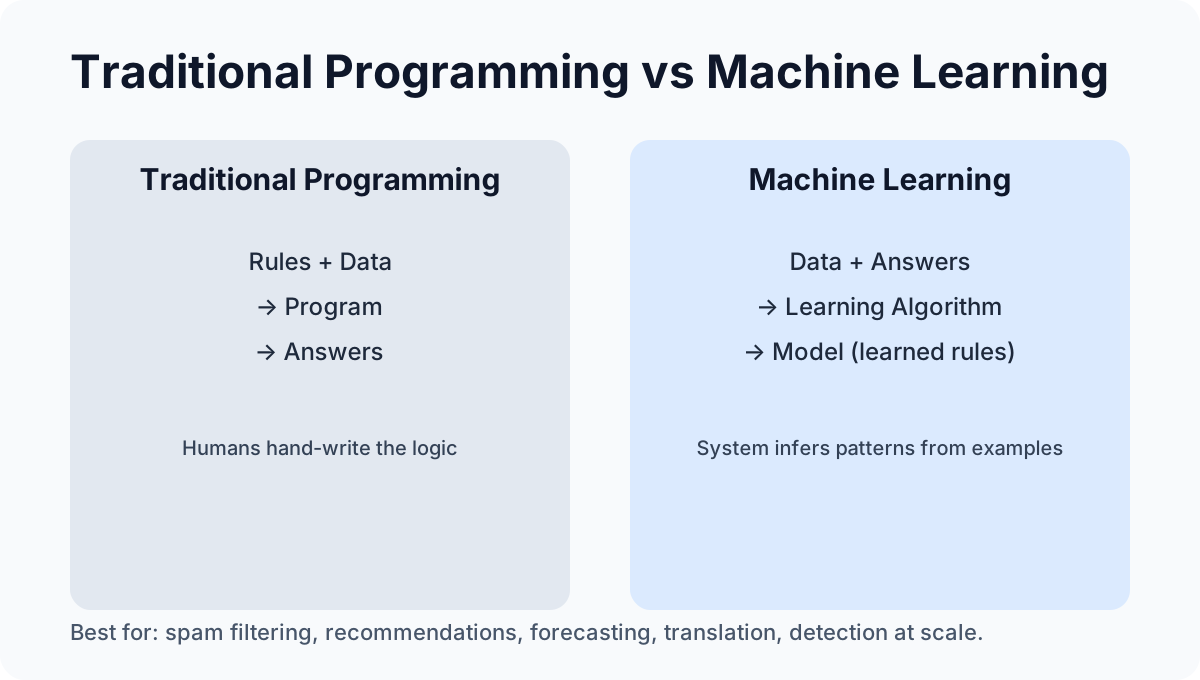
Both approaches produce working software. But ML produces software that can improve — and handle patterns too complex for humans to write by hand.
The one-sentence definition
Machine learning is a way to make software improve at a task by learning from examples instead of hard-coded rules.
Where you already use ML every day
Machine learning is not a future technology. You interact with it dozens of times every day:
- Email spam filtering learns from millions of labeled examples to spot patterns no human could enumerate
- Maps traffic prediction infers congestion from the aggregate speed of devices on the road right now
- Social feed ranking learns from engagement signals which content to surface for each specific user
- Shopping recommendations identify purchase intent from browsing patterns across millions of products
- Voice assistants convert audio waveforms to text using models trained on thousands of hours of speech
- Bank fraud alerts detect anomalies in transaction patterns that have never been explicitly defined as fraud
If a system gets better with more examples, machine learning is involved.
Why ML became so important
Some problems are too messy for fixed rules. Spam detection is the classic example. A rule like “contains FREE = spam” fails immediately — legitimate companies use the word “free” constantly. A rule like “sender not in address book = spam” has too many false positives. By the time you’ve written 50 rules, sophisticated spammers have found workarounds for each one.
ML handles this by learning combinations of signals no human would think to encode. Not “contains FREE” but “contains FREE AND was sent before 6am AND links to a domain registered within 30 days AND the sender has sent to 5,000 addresses in the last hour.” These patterns emerge from the data, not from a programmer’s intuition.
That’s ML’s core advantage: finding subtle, multi-factor patterns at a scale humans can’t manually maintain.
What ML is not
ML is not magic. It is not always correct. It does not think independently or make value judgments. It is pattern recognition under uncertainty.
It makes mistakes — sometimes obvious ones, sometimes subtle ones. It can learn the wrong patterns if the training data has biases. It can work perfectly in testing and fail in deployment when the real world differs from the training data.
Great ML systems are not “perfect models.” They are well-scoped models with strong human oversight.
The ML improvement loop
Understanding how ML systems get better is what distinguishes practitioners who can deploy reliably from those who get impressive demos and production failures.
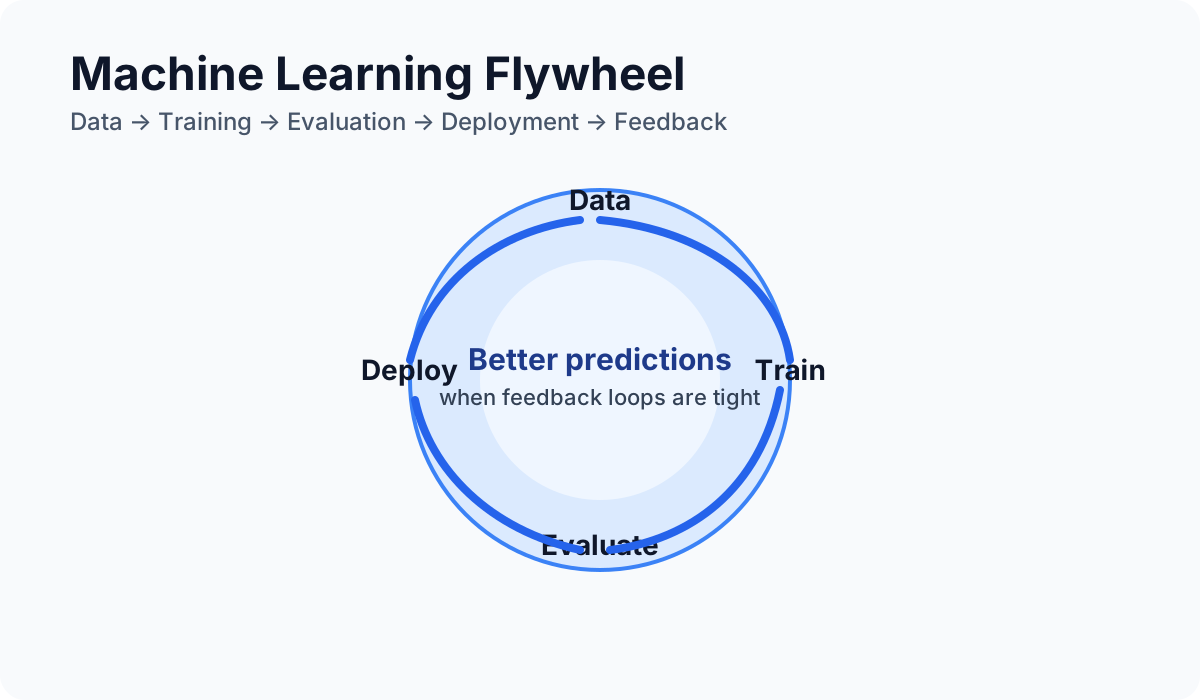
The cycle works like this: collect data from real interactions, train a model on labeled examples, deploy carefully with human oversight, monitor where the model makes mistakes, capture that feedback, and retrain on the improved dataset. Each loop, if run correctly, produces a better model.
The diagram below shows this flywheel. The key insight is that data quality drives the loop — a good model in a weak data loop will degrade; a modest model in a strong data loop will improve.
Why people get disappointed with ML
Usually not because the technology is weak. Usually because of one of these:
Poor quality data. Training on noisy, inconsistent, or incorrectly labeled data produces models that learn the noise. Garbage in, garbage out applies with unusual precision to ML.
Wrong success metric. Optimizing a model for accuracy when the business needs precision on a specific class is a common mismatch. Define what “good” means in business terms, then translate it to a model metric.
Weak evaluation before launch. A model that looks good on aggregate accuracy metrics can have catastrophic failure modes on specific subgroups. Evaluate per-slice before shipping.
No monitoring after launch. The world changes. Data distributions shift. A model that worked in January can degrade quietly by June. Monitoring is not optional.
Using ML for the wrong problem. If you need deterministic, explainable, rule-based logic — use rules. ML is the right tool for problems with complex patterns in large data, not for every decision a software system makes.
How to know if ML is the right fit
Use ML when:
- You have repeated, frequent decisions (thousands or millions per day)
- You have clear feedback or outcome data to learn from
- Large amounts of historical examples are available
- Small improvements in accuracy create meaningful business value
- The patterns are too complex to enumerate manually
Be cautious about ML when:
- You need perfect deterministic correctness every time
- The stakes are high but quality data is limited
- Policy, compliance, or audit requirements need explicit logic
- The cost of being wrong significantly outweighs the benefit of automation
Try this now
Find one repeated task in your work where decisions are made frequently and outcomes are measurable. Ask:
- How many examples of this decision exist historically?
- What does “right” look like — can it be measured?
- What’s the cost of a wrong decision?
If the answers are “thousands of examples,” “yes, measurable,” and “acceptable if humans review edge cases” — you have a strong ML candidate. If the answer to any of these is “not sure,” that’s your investigation starting point, not a reason to build.
Pitfalls and failure modes
Assuming the model learned what you intended. ML models learn correlations, not causes. A model that appears to predict outcomes well may have learned a spurious correlation — if that correlation breaks in the real world, performance collapses without warning.
Treating test accuracy as deployment accuracy. Test sets should represent the deployment distribution. When they don’t — which is common — test metrics overstate real-world performance. Always validate on production-representative data before shipping.
No feedback loop for model errors. When a model makes a mistake and no one captures it, the model can’t improve. Building feedback capture into the product from day one is significantly cheaper than retrofitting it later.
Final mental model
Machine learning is not “AI replacing humans.” It is software that learns useful patterns from examples so humans can make better, faster decisions on problems that are too complex for explicit rules.
That’s the real story. The rest — the architectures, the algorithms, the benchmarks — is implementation detail built on top of that core idea.
Go deeper
Machine Learning in the Real World — A Practical Playbook →
Related reads
Stay ahead of the AI curve
Weekly insights on AI — explained at the level that's right for you. No hype, no jargon, just what matters.
No spam. Unsubscribe anytime. We respect your inbox.